Hit counter

~WELCOME~

Wednesday, 23 April 2014

Terracotta Army


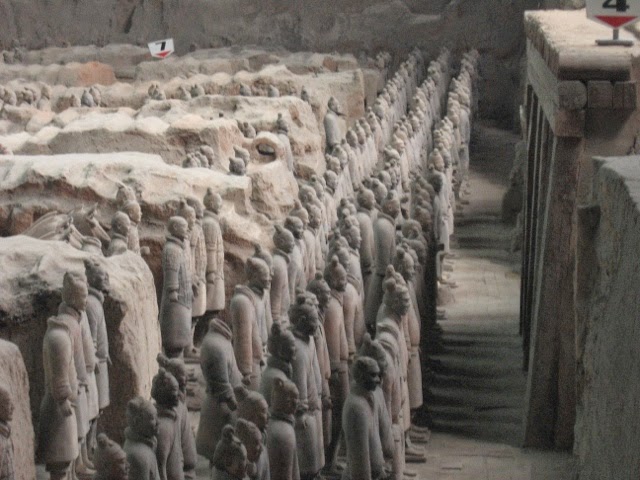
The Terracotta Army or the "Terracotta Warriors and Horses" is a collection of terracotta sculptures depicting the armies of QIn Shi Huang, the first Emperor of China. It is a form of funerary art buried with the emperor in 210–209 BC and whose purpose was to protect the emperor in his afterlife.
The figures, dating from approximately the late third century BC, were discovered in 1974 by local farmers in Lintong District, Xi'an, Shaanxi province. The figures vary in height according to their roles, with the tallest being the generals. The figures include warriors, chariots and horses. Current (2007) estimates are that in the three pits containing the Terracotta Army there were more than 8,000 soldiers, 130 chariots with 520 horses, and 150 cavalry horses, the majority of which are still buried in the pits nearby Qin Shi Huang's mausoleum. Other terracotta non-military figures were also found in other pits and they include officials, acrobats, strongmen, and musicians.

To me, the idea of Terracotta Army is pretty cool as the background idea of how they are supposed to protect the Emperor in his after life amuses me. It shows how the Ancient a China has their own strange beliefs, whether the idea of having Terracotta Army works or not, nobody knows, but the China still have a strong believe in their superstitious culture.

We can learn that the China Emperors in the past possesses authority over his people and is highly respected. He even had his own army that could supposedly protect him in his after life. It shows us that he is demanding and takes pride in himself greatly. 

-clinton

Friday, 11 April 2014

Great Wall of China/ 万里长城


Length: 8,851.8 km (5,500 miles)


Construction Period: About 2,000 years from the Warring States Period (476 BC - 221 BC) to Ming Dynasty (1368-1644)

   The ancient Chinese laboring people (common people, farmers, soldiers and slaves)
, had built the wall so as to protect the Chinese Empire against intrusions by various nomadic groups or military incursions by various warlike people or forces, such as the Mongols.
     Several walls were being built as early as the 7th century BC; these later joined together and made bigger and stronger, are now collectively referred to as the Great Wall. Especially famous is the wall built between 220–206 BC by the first Emperor of China, Qin Shi Huang. Though little of that wall remains, as the Great Wall has on and off been rebuilt, maintained, and enhanced.
      The Great Wall, one of the greatest wonders of the world, was listed as a World Heritage by UNESCO in 1987. Just like a gigantic dragon, the Great Wall winds up and down across deserts, grasslands, mountains and plateaus, stretching approximately 8,851.8 kilometers (5,500 miles) from east to west of China.
    The Great Wall of China is of great significance to the Chinese. Even including it in a part of their national anthem, “Let our flesh and blood forge a new Great Wall!”, proving it an iconic symbol of China. Many people died during its construction, due to the heavy work, short time limit and tough conditions, archaeologists having discovered many human remains buried under sections of the wall. The Great Wall serves as a monumental importance to the modern people of China today, a symbol of their ancestors’ patriotic act. The Chinese having a well-known saying that translates to: “If you haven’t climbed the Great Wall, you’re not a real man."

The Great Wall of China

http://www.shedexpedition.com/wp-content/uploads/2013/02/great-wall-of-china.jpeg
Sources:
http://www.travelchinaguide.com/china_great_wall/facts/who-built.htm
http://en.wikipedia.org/wiki/Great_Wall_of_China

Tuesday, 8 April 2014

Beijing Olympics 2008 (Beijing National Stadium) -Audrey

History 

Located at the Olympic Green, the stadium cost US428 million. The design was awarded to a submission from the Swiss architecture firm Herzog & de Meuron in April 2003 after a bidding process that included 13 final submissions. The design, which originated from the study ofChinese ceramics, implemented steel beams in order to hide supports for the retractable roof; giving the stadium the appearance of a bird's nest. Leading Chinese artist Ai Weiwei was the artistic consultant on the project.[5] The retractable roof was later removed from the design after inspiring the stadium's most recognizable aspect. Ground was broken on 24 December 2003 and the stadium officially opened on 28 June 2008. A shopping mall and a hotel are planned to be constructed to increase use of the stadium, which has had trouble attracting events, football and otherwise, after the Olympics.[6]

(Taken from: http://en.wikipedia.org/wiki/Beijing_National_Stadium) 

My Reflections 
From this iconic stadium that the Olympics were held at, I am able to see how China displays their sporty cultures. I believe in the eyes of many, China has have a very good sports records in which they hav earned many awards and medals from various international competitions. 

Friday, 14 March 2014

Retreat of nationalist


This picture shows the retreat of KuoMingDang during World War Two and during the civil war. 
From Nanking to canton and to Sichuan. This means shame and nationalists  had no power to protect its own country . Their military power is very weak. Despite defeated by the Japanese for several times , the nationalists did not give up and surrender . Chinese people also play a important role , they support the country and are willing to go to the war to fight against Japanese. During the Second Sino Japanese war ,most Western historians believed that the total number of casualties was at least 20 million.The Chinese have resilience and loyal to the country . They are also willing to sacrifice themselves and protect their homeland. China had been invader by foreigners several times and the people know the consequence of being invader by a foreigner country.
From Sichuan to Taipei, the people in china was disappointed with the government. As the nationalist did not give them more benefit than the communist , the public no longer support.  Although the number of soldiers that the nationalist have is more than the number of soldiers that communism have , the communisms still won the war with millions of Chinese help them to transports weapons and foods. 
The public were used to support the party than gave them more benefit as that was what had happened in the china for the past centuries . 
From this , we can learnt that support from people is very important .  The water that bears the boat is the same that swallows it.
Source: http://en.wikipedia.org/wiki/Republic_of_China_(1912–49)

Thursday, 13 March 2014

The Terracotta Army/ Terracotta Warriors and Horses


The Terracotta Army/ Terracotta Warriors and Horses 
   The Terracotta Army ---- ever wondered about its origins and its history?     
    A collection of terracotta sculptures depicting the armies of Qin Shi Huang, the first Emperor of China, and one of the most fascinating archeological discovery of modern time in Shaanxi province, China. The Terracotta Army is made out of with terracotta, literally meaning “baked earth”, natural clay, being officially uncovered in 1974 while a group of peasants were digging up a well near the royal tomb. As a form of funerary art, it was ‘buried’ with Emperor Qin Shi Huang in 210–209 BC, whose purpose was to protect the emperor in his afterlife, and took around 700,000 craftsmen and over a span of 36 years to construct!

   The mausoleum, with the Emperor’s tomb stationed in the centre, have four pits of battle-ready warriors stationed near the tomb. The first pit, as large as two football fields, with around 6000 warriors, made up of archers, charioteers, foot soldiers, etc. in battle-ready formation. A smaller second pit nearby was filled with approximately 900 warriors who are more powerful and have higher ranks such as generals. The third pit is where strategists and scholars are located to discuss battle formations. The fourth and final pit was discovered empty, scholars befuddled by this. Servants, acrobats, dancers, singers, strongmen, and animals were also excavated, serving as entertainment to the Emperor while the warriors ‘protect’ the Emperor and his afterlife kingdom. So much thought and effort being put into the crafting of the army, no two figures having the same facial features, hair styles and clothing design, each having its own unique identity.
   For China, the Terracotta Army is something of great value to them, in honour of the First Emperor, and showed the huge amount of respect the Chinese had for the Emperor, and his importance to them. For me, the Terracotta Army is a projection of the great history of China, showing us a great deal of information of Ancient China, about the Qing Dynasty, their distribution and formation of ranks, use of weapons and the application of military tactics, etc., a window to what China was like back then.


The Terracotta Army

http://thumbs.media.smithsonianmag.com//filer/terra-cotta-soldiers-631.jpg__800x600_q85_crop.jpg


SOURCES: http://en.wikipedia.org/wiki/Terracotta_Army
http://www.personal.psu.edu/dvz5004/terracottaStyle.html

-Shenice :) 

Friday, 7 March 2014

China one party rule

What do you think are some advantages and disadvantages of the one party system in China?
The disadvantage is that the country will suspect the party to corrupt as there are no other party to guide them. 
The advantages is that they can easily work together as they are one party

How far do you think the one party system is to blame for China's poor human rights record?
They were to blame as they were working together and causing the china poor humans right.

Why do you think China has been able to progress with the one party system?
As they agree to each other and did not cause a disruption.


Do you think that maintaining a one party system will continue to benefit China?
Yes. They will continue to develop as one China as it would be easier with one leader which has the ability to influence the people of China, without any objections or discussions. Things can be done much more smoothly and agreements would come along easily. 

Do you think that the China's one party system is similar to Singapore's?
No Singapore got other parties to who work with the government.

What can both countries learn and not learn from each other in terms of governance?
Yes they can learn from each other in terms of what is good and what they should not do. They can also share their experiences with different political systems and contribute to the development of both nations respectively. They can also learn from each other's mistakes and prevent various disasters, economically or physically, by taking precautions. 

Tuesday, 11 February 2014

Poverty in Singapore :(


     Though it is rather unlikely for beggars to be on the streets, or starving children roaming around for food, in Singapore, just like every other country, Singapore still has its poor. With people basking, collecting garbage for sale, etc. However, compared to many other less-developed countries, poverty in Singapore can be considered as non-prevalent.
     
    - What is the poverty rate in Singapore?
    - How has it changed over the years?
    - Our poverty rate compared to other countries?


      The poor here struggle with ‘relative poverty’, where financial resources aren’t sufficient to pay for the necessities of living in Singapore, where the standard of living is very high. The poverty line (though not defined by the government) in Singapore would be an income of less than S$1500 per month. With 458,257 people living under the poverty line, according to CPF Annual Report in 2011 (the government omitting info from 2012), 26% of Singaporeans are living in poverty.
    From 2002-2011, the poverty rate increased by 1% on average per year. As of 2011, the proportion of people living in poverty and of high-income has grown, whereas middle-class has shrunk tremendously.
    
     The poor suffered as more people got wealthy, the standard of living only getting higher, causing more people to fall into poverty as well.

    Among the developed countries and others around our region, we have one of the highest poverty rates!

The factors impacting the poor’s plight often involve systemic issues like housing and employment, which may take many generations to overcome, however some concrete things can be done. Programmes like money-management workshops can allow children to grasp the concept of money and how to use it wisely, and be successful in the future.

sources:
http://thehearttruths.com/2013/10/28/poverty-in-singapore-grew-from-16-in-2002-to-28-in-2013/
http://www.mws.org.sg/Dispatcher?action=SocialIssueTopic&id=Sc12ce388725076